

· Greenback· Precious Metals
Silver's Selloff: What It Signals About the Economy
Silver's recent plunge isn't just a precious metals story — it's a warning sign about the broader economic landscape. While gold has pulled back, silver has fallen harder and faster, and the reasons why should matter to every investor watching the macro picture.
Silver's Selloff: What It Signals About the Economy
A Tale of Two Identities
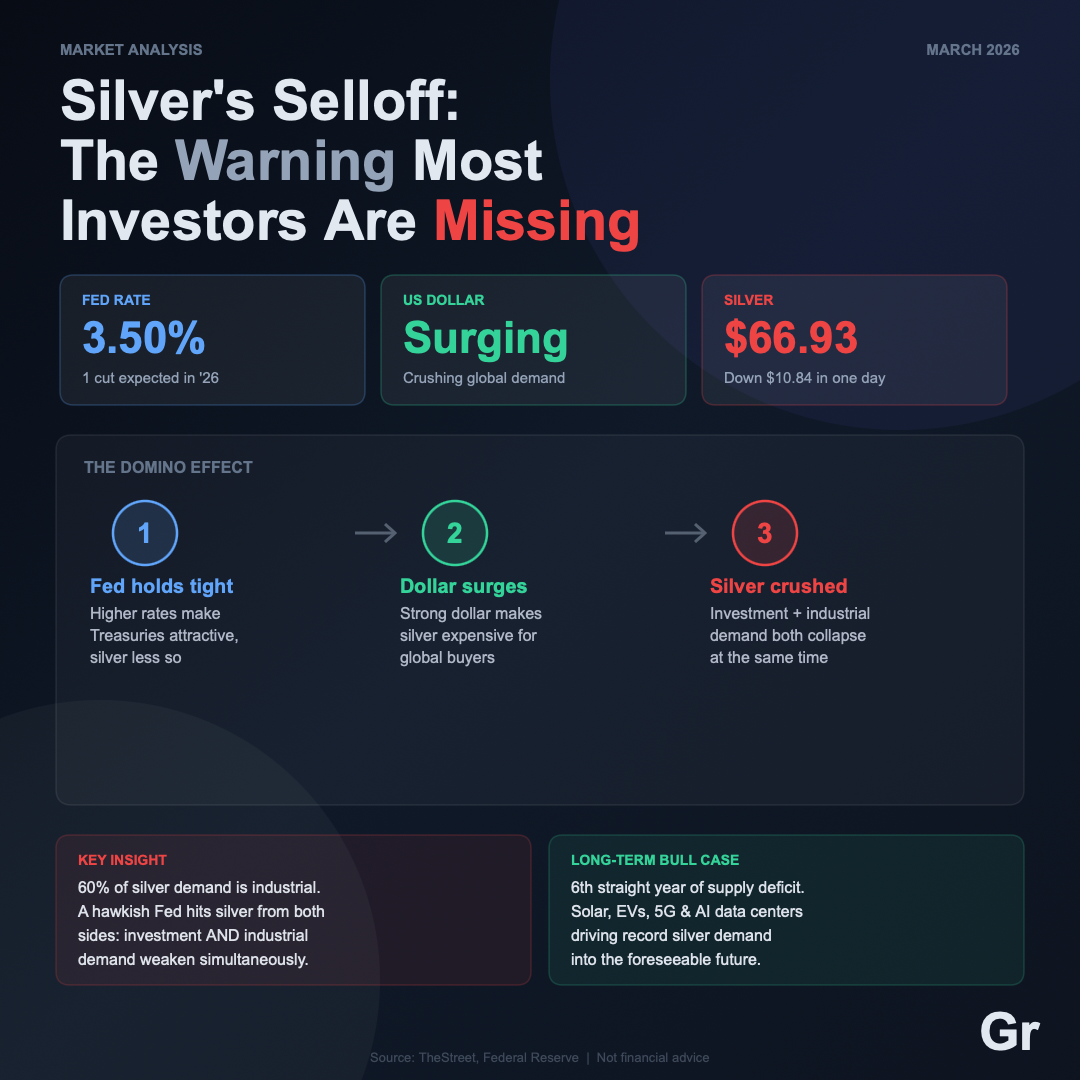
Unlike gold, which functions primarily as a safe-haven asset, silver lives a double life. Roughly 60% of its demand comes from industrial applications — solar panels, EV batteries, electronics, and medical equipment. That dual identity means silver gets hit from both sides when the economic outlook darkens: investors sell it alongside gold, and industrial buyers pull back at the same time.
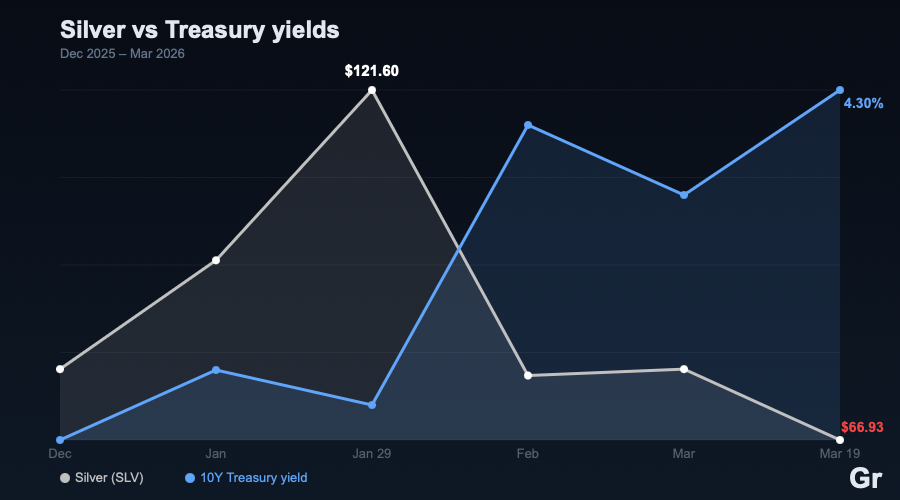
That's exactly what's happening now. After an extraordinary 2025 rally that saw silver gain 135% and reach an all-time high near $121 per ounce in late January, the metal has undergone a brutal reversal. A single-session crash of 33% in late January — triggered by shifting expectations around Federal Reserve leadership and monetary policy — set the tone for weeks of instability.
The Fed Factor
The Federal Reserve's decision on March 18 to hold rates steady at 3.5%–3.75%, paired with a signal of just one rate cut for the rest of 2026, dealt another blow. Higher-for-longer rates raise the opportunity cost of holding non-yielding assets like silver and gold. But silver bears the additional burden of weakening industrial demand, as manufacturers and solar project developers pause purchases amid uncertainty and price volatility.
A stronger dollar has compounded the problem, making silver more expensive for international buyers and suppressing global demand.
The Long-Term Case Hasn't Changed
Despite the short-term pain, silver's structural story remains compelling. The Silver Institute projects a sixth consecutive year of supply deficit in 2026, driven by surging demand from clean energy, 5G infrastructure, and AI data center construction. Solar manufacturing alone is expected to consume record volumes of the metal this year.
The challenge is that long-term fundamentals don't set short-term prices. Right now, leveraged fund liquidations, dollar strength, and a hawkish Fed are in the driver's seat.
What to Watch
Silver's path to stabilization depends on the same forces that knocked it down. A softer inflation reading that revives rate cut expectations could weaken the dollar and lift precious metals broadly. Signs that industrial demand — particularly from solar and EV manufacturers — is holding up would help close silver's widening gap with gold.
For now, silver is caught between a strong structural future and a painful present. Investors would be wise to watch it closely — not just for what it says about the metal itself, but for what it reveals about the health of the broader economy.