

· Greenback· Federal Reserve
The Fed Holds Steady: What Today's FOMC Decision Means for the Economy
The Federal Reserve held its ground today, keeping the federal funds rate at 3½ to 3¾ percent following its March 17-18 meeting. The decision was nearly unanimous. Only Stephen Miran dissented, preferring a quarter-point cut, and this signals that the Fed remains in wait-and-see mode as it navigates a familiar tension: solid economic growth on one side, stubbornly elevated inflation on the other.
The Fed Holds Steady: What Today's FOMC Decision Means for the Economy
The Economy Today: Growing, but Not Without Caveats
The Committee's statement paints a picture of an economy that continues to expand at a "solid pace," but with some soft spots. Job gains have been low, though the unemployment rate has held steady in recent months. Inflation, meanwhile, "remains somewhat elevated" — a phrase the Fed has used for some time now, and one that explains much of its caution.
Adding to the uncertainty, the statement flagged developments in the Middle East as a wildcard for the U.S. economic outlook. The Committee noted it is "attentive to the risks to both sides of its dual mandate," a nod to the possibility that growth could slow or inflation could reignite depending on how geopolitical events unfold.
The Projections: A Slightly Brighter and Stickier Picture
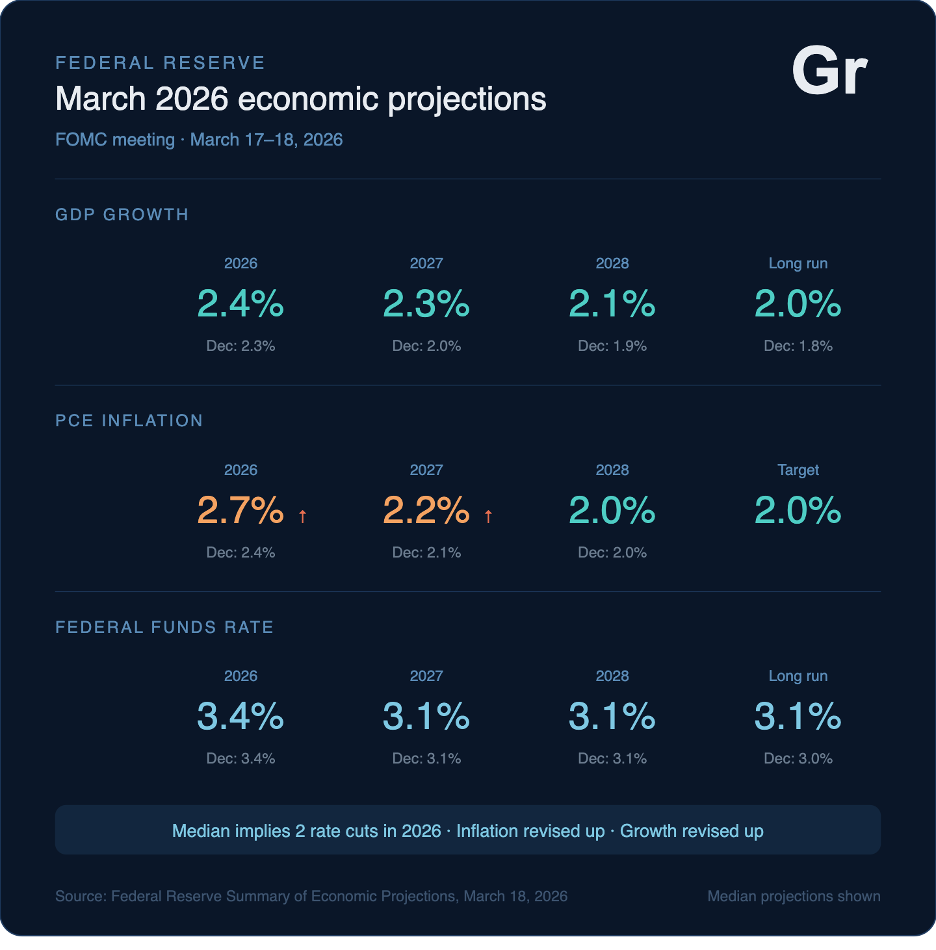
The updated Summary of Economic Projections (SEP) offers more detail on where Fed officials think things are headed. Compared to December's projections, the outlook has shifted modestly: participants now see stronger growth but also higher inflation in the near term.
The median projection for real GDP growth in 2026 ticked up to 2.4 percent from 2.3 percent in December, with growth expected to gradually settle toward a longer-run pace of 2.0 percent by 2028. The unemployment rate is projected to edge up slightly to 4.4 percent this year before drifting down to 4.2 percent by 2028, essentially at the level participants consider full employment.
On inflation, the picture is less reassuring. The median PCE inflation forecast for 2026 jumped to 2.7 percent, up from 2.4 percent in December, with core PCE also rising to 2.7 percent from 2.5 percent. Participants still expect inflation to return to the 2 percent target — but not until 2028, suggesting the last mile of disinflation is proving slow.
Rate Cuts: Still on the Table, but Don't Hold Your Breath
The dot plot tells a patient story. The median projection for the federal funds rate at year-end 2026 sits at 3.4 percent, unchanged from December, implying roughly one more quarter-point cut this year from the current level. Looking further out, participants see the rate settling around 3.1 percent by the end of both 2027 and 2028, with a longer-run neutral rate of 3.1 percent.
In short, the Fed is projecting a very gradual easing path. The days of back-to-back rate cuts appear to be behind us, replaced by a more deliberate approach driven by how quickly inflation cooperates.
The Bottom Line
The U.S. economy remains on solid footing, but the Fed clearly isn't ready to declare victory on inflation. Today's hold and the updated projections suggest policymakers are comfortable being patient, even as markets look for signals on the next move. With geopolitical risks elevated and price pressures lingering, the message from the Fed is clear: data will dictate the pace, and there's no rush.